Motivation, the Brain & the Systems Around Us
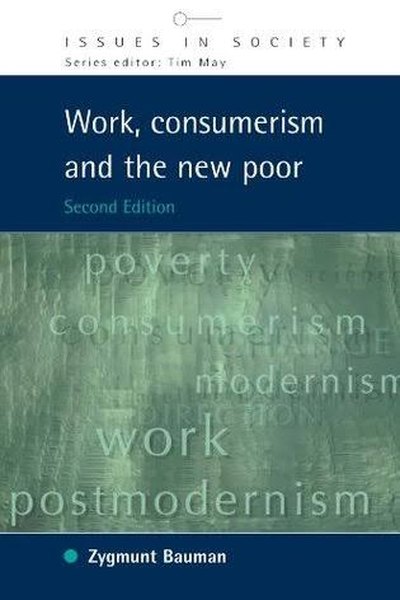
Work, Consumerism and the New Poor
"Everyone has to work." It sounds like a law of nature.
The sociologist Zygmunt Bauman asks where that idea came from, and whether it was always there.
Bauman was born in Poland, spent most of his career teaching at the University of Leeds in England, and died in 2017, leaving behind more than fifty books. He's best known for the idea of "liquid modernity." This short book, published in 1998, is slim, but it's about a big shift: how we moved from a society of producers to a society of consumers.
The work ethic was manufactured. Early in the Industrial Revolution, factories needed huge numbers of people willing to show up on time. So "work is a virtue in itself" and "idleness is shameful" became the new moral rules. What work meant was no longer defined by craftspeople themselves but by a system outside them.
In a consumer society, we answer "Who am I?" by choosing. An assembly line can't tell you who you are; millions of people "work in finance." Consumption offers endless options, and we believe our choices express who we are. Even jobs start getting picked like products: a good job should be interesting, should be an experience. But "interesting work" is a privilege only a few get.
The new poor are "flawed consumers." In a society of producers, the poor were a reserve of labor, temporarily out of work and waiting to be called back. In a society of consumers, the poor are people who can't play the consumer game. Poverty gets reframed as a failure of personal choice, even a flaw of character.
One idea I really agree with: the most striking thing about consumerism isn't its frenzy. It's a kind of obsession that looks perfectly rational and self-controlled. "I haven't lost my head. I know exactly why I'm spending this."
Some people say the culture of traveling for the perfect photo has the same core as consumerism: a loop of brief pleasure, lasting emptiness, and stronger craving. My take: I'm not against taking great photos. I'm against trips that exist only for the photos. If your head is full of where the best angle is and what pose to strike, there's no room left to see what's in front of you.
I've long believed that when you work only to spend, and spend to recover from the exhaustion of work, you're stuck going in circles. The first step out is redefining what's "worth it."
Bauman didn't make me hate work. If anything, he made me want to take it more seriously. I love building things from zero to one, turning an idea into an actual product. What he helped me separate are two things: work can be a way to create value and express yourself, but the question "Who am I?" shouldn't be handed over entirely to a paycheck and a shopping cart.
Read it if you've ever wondered what all your hustle is actually for. It won't teach you to declutter, but it will show you the rules of the game.
In a consumer society, the poor are no longer the unemployed. They're the "flawed consumers."