Thinking, Writing & Other People
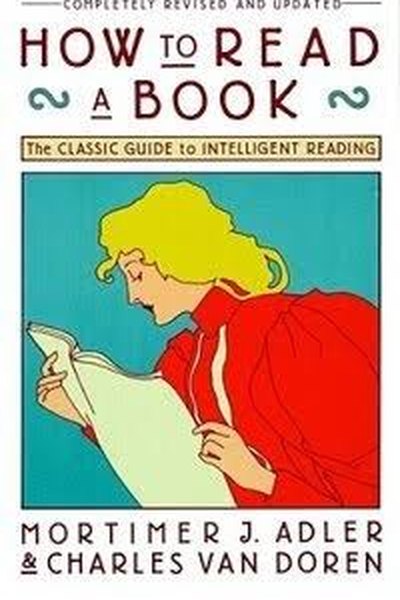
How to Read a Book
You know the feeling. You finish a book, and six months later all that's left is "Oh yeah, I read that one."
That was how I read in college. Before starting anything, I had to be sure it was a certified Good Book, so I wouldn't waste my time. I kept count of how many books I'd read that year, like the number was a medal. And I never abandoned a book, however much I was struggling, because quitting halfway felt shameful, like proof that something was wrong with me. Looking back, it was reading as self-punishment. Reading for the sake of reading. I got through a lot and kept very little.
What pulled me out of it was a book about how to read.
Adler was an American philosopher. The book first came out in 1940 and was heavily revised in 1972 with his editor Charles Van Doren; that's the version we read today. The title sounds like it's teaching kids their letters. The question it actually asks is one most adults never think hard about: are you reading to know more, or to understand more?
Books you already understand won't make you smarter. Adler splits reading in two. One kind is reading the news: you're already at the level of the text going in, and you come out with a few more facts. The other is reading something that's a notch above you, something you don't fully get at first. Only the second kind makes your mind grow. Read a hundred books of the first kind and your count goes up. Your ability doesn't move.
The reader isn't the ball. The reader is the catcher. The writer pitches, the reader catches, and catching is just as active as pitching. The only passive thing in the game is the ball. How much of a book you catch depends on how hard you're working.
There are four levels of reading. Elementary reading is decoding the words. Inspectional reading is skimming fast to work out what a book is about and whether it's worth your time. Analytical reading is taking an X-ray of the book: finding its skeleton, restating the author's argument in your own words, then deciding whether you agree. The top level is syntopical reading, where you read several books at once to answer a question of your own. I love the picture this creates. You're the host, and you've seated authors from different centuries and countries around one table. You ask the questions. You set the agenda.
A truly great book stays ahead of you. Some books disappoint on a reread, because you've grown and they now look smaller. But a rare few are above you the first time, still above you the second time, and will probably stay above you for good. Those are the ones worth reading again and again.
Being confused is part of the job. If you close a good book with some puzzle still nagging at you, you haven't failed. You've started.
This book changed how I think about reading. "I like it" is reason enough to read something. If a book isn't working, I put it down; there are too many good ones out there. I started rereading, and now I spend more time rereading than reading new things. I stopped caring how many books I finish in a year.
There's a comparison I love: reading is like eating. You don't feel any different after one bowl of rice, and nobody can see a change. But all those bowls, year after year, became your body. Books work the same way. One book rarely changes you on the spot. But when what you read collides with what you've lived and thought, it quietly becomes part of you. The more you read, the more you realize how much you don't know. You'll never reach the edge of knowledge, but you'll always be bigger than the frame you started with.
Read it if you've ever read for the number and walked away with nothing. It'll make you fall back in love with reading, and read deeper.
Perhaps you are beginning to see how essential a part of reading it is to be perplexed and know it.