Motivation, the Brain & the Systems Around Us
Thinking in Systems
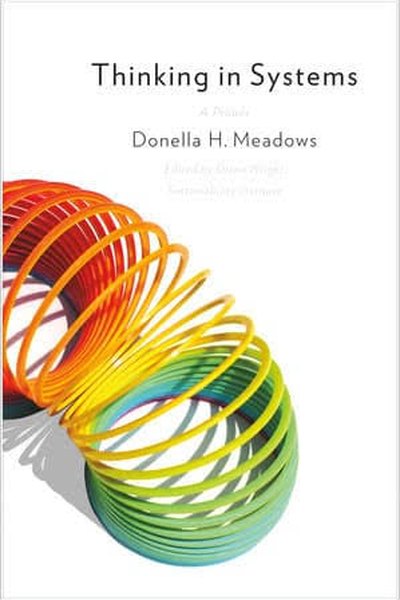
Hold a Slinky in your palm, grip the top with your other hand, then pull the bottom hand away. The Slinky drops, springs back up, and keeps bouncing.
Why? Because you moved your hand? Donella Meadows pulled out this toy in every systems class she taught and asked her students exactly that. The answer: the bouncing is built into the Slinky's own structure. Your hand just released it.
That is pretty much the whole book: a system's behavior comes from its own structure.
Meadows was an environmental scientist and the lead author of The Limits to Growth, the 1972 report that shook the world. This beginner's guide for general readers wasn't published until 2008, after her death.
Her tools are startlingly simple. Take a bathtub. The water in it is a "stock"; the faucet and drain are "flows." To raise the water level, you can turn the faucet up, or you can slow the drain. Sounds obvious, yet in real life we fixate on the inflow. One level up are two kinds of feedback loops. One works like a thermostat, pulling the system back toward a target. The other works like a snowball, growing bigger as it rolls, which can be a virtuous circle or a vicious one.
Stocks take time to change. So don't buy "form a habit in 21 days, get rich in six months." Don't force the seedling, and don't give up on it too early either.
Tweaking the numbers is the weakest way to change anything. The book lists 12 "leverage points," from weakest to strongest. The ones we reach for most often, adjusting figures and adding budget, are the least effective. One story from the Netherlands makes the point: in a housing development, some homes had their electricity meters in the basement and others had them in the front hall. The front-hall homes used a third less electricity. Nothing else changed. The information was just visible.
The highest leverage is changing the paradigm. That is, the story and goals a society takes for granted.
I work with data and models every day, and this book was like a new pair of glasses. Meadows says every model is a simplification of reality, and that a model's value isn't whether its scenarios come true, but whether it captures how the system actually behaves. I come back to that idea again and again.
Lots of readers have written about this book, and a few of their takes line up almost exactly with mine:
When you hit a problem, maybe the first step isn't analysis. It's drawing the boundary. How big you draw the system decides what you're able to see.
Structure drives behavior, and behavior drives events. If you only look at events, you can only ever react to them.
And one about sticking with things: with something like reading, the payoff is always delayed. So focus on the choice, not the return. Choosing to pick up the book is itself the positive feedback.
Meadows also jokes that once you start seeing feedback loops everywhere, you're already in danger of becoming a systems thinker. After this book there's probably no going back. Now when I see a problem, I automatically ask: What's the stock here? Which loop is in charge? Can anyone actually see the information?
Read it if you keep falling into the same hole, or if you're working hard and the results feel wildly out of proportion.
"The system, to a large extent, causes its own behavior."