Motivation, the Brain & the Systems Around Us
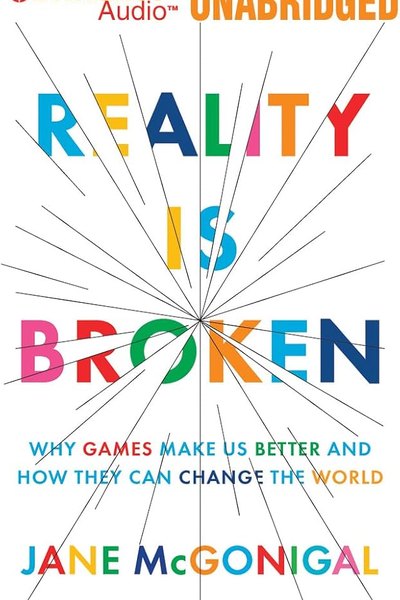
Reality Is Broken
People around the world spend more than three billion hours a week playing games.
Most people hear that number and think: what a waste. Jane McGonigal thinks the opposite. She's a game designer and a researcher at the Institute for the Future in California. Her question: if that many people willingly put themselves through hardship in games, maybe reality is failing to give us something?
The book came out in 2011, and her answer is yes. Games reliably give us four things: satisfying work, the hope of success, connection with other people, and the chance to be part of something bigger than ourselves. Real life often comes up short. She lists the ways reality is "broken" one by one and offers a fix for each, fourteen in all.
Fix number one: compared with games, reality is too easy. The philosopher Bernard Suits defined playing a game as the voluntary attempt to overcome unnecessary obstacles. In golf you could just walk over and drop the ball in the hole. Instead we hit it from hundreds of yards away with a stick. What people need isn't ease. It's a challenge we chose ourselves, hard enough to matter.
Fix number five: stronger social connection. She talks about FarmVille on Facebook. The gameplay is simple, but friends send each other gifts and tend each other's farms, and that light, drop-in-anytime contact keeps people in touch.
The second half of the book is about applying these fixes to the real world. Chore Wars turns doing the dishes and taking out the trash into a role-playing game where housework earns you experience points. In World Without Oil (2007), around 1,900 players imagined an oil crisis and documented how they'd live through it. At the University of Washington, Foldit invited ordinary players to fold proteins; on some structural puzzles they beat computer algorithms, and the results were published in Nature.
The opposite of play isn't work. It's depression. The line comes from play researcher Brian Sutton-Smith. Games make us happy precisely because they're hard work we chose for ourselves, with clear goals and instant feedback.
Good games make failing fun. When we lose a game, we laugh and hit "play again," because we believe we'll win the next round. That kind of optimism is exactly what a lot of us are missing in real life.
You don't have to escape reality. You can redesign it. She isn't telling you to hide in games. She's telling you to borrow game design to make real things more worth throwing yourself into.
The chapter that hit me hardest was the one on social connection. In China right now, people look for a dazi for everything: a meal buddy, a gym buddy, a study buddy. I think that's really the "ally" or "guild" from games: a group of people working toward the same goal, seeing each other and pushing each other on. Finding readers who think like you through the reviews and margin notes on WeChat Reading works the same way. It's a very efficient social reward.
Some of it made me a little sad, too. You can restart a game; you can't restart a life. When we play, we know the level can be beaten, so we keep up an almost unreasonable optimism. In real life, a new project lands on your desk and the first feeling is often anxiety: can this even be done? Reality is frustrating not because the world is so bad, but because that "next round I'll get it" optimism is so hard to come by.
Some reviewers find the book too preachy, too quick to make complicated problems sound simple. I agree it's overly optimistic in places. But it gave me one very practical idea: you can design a hard thing like a level. Break it into small tasks, give yourself instant feedback, and find an ally.
Read it if real-world feedback always feels too slow and too thin, or if you've ever wondered why someone can forget to eat while gaming but can't get going at work.
"The opposite of play isn't work. It's depression."