Motivation, the Brain & the Systems Around Us
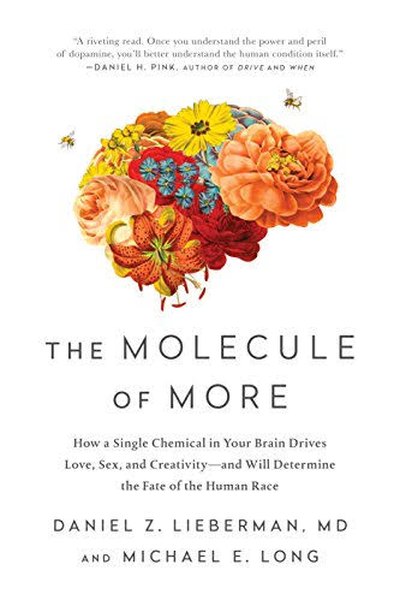
The Molecule of More
What's the best moment of online shopping? Hitting "pay," and those few seconds of tearing open the box. Once the thing is actually sitting on your desk, it's kind of... fine.
This book explains why. Daniel Lieberman is a psychiatrist; Michael Long is a writer with a physics background. They set out to correct a popular idea: that dopamine is the "pleasure molecule."
They walk through neuroscientist Wolfram Schultz's monkey experiments. A light comes on, meaning there's food in a certain box. At first, the monkeys' dopamine cells fire when they find the food. But once a monkey figures out the rule (light means food), the dopamine spike moves forward to the moment the light turns on, and the food itself barely registers. What excites the brain isn't the reward. It's the surprise of things turning out better than expected.
Dopamine isn't the pleasure molecule. It's the desire molecule. It's in charge of what you don't have yet: what's far away, in the future, just out of reach. The authors' image is easy to remember. Look down and you see what you already have. Look up and you see what dopamine wants.
Wanting and liking are two different things. When psychologist Kent Berridge boosted dopamine in rats, they drank more sugar water but didn't seem to enjoy it more. Only when he boosted a different set of "here-and-now" chemicals did they actually savor the sweetness. Stronger desire doesn't mean deeper enjoyment.
Having is boring. Getting is what's exciting. It's also why the honeymoon phase fades. Anthropologist Helen Fisher's research suggests passionate love lasts roughly 12 to 18 months; after that, a relationship has to run on different chemistry and become companionate love.
But the book isn't telling you to quit wanting things. Dopamine has a second circuit, the one that plans, imagines and models, and lets us resist temptation now for a bigger goal later. As the authors put it, the thing that can push back against dopamine is dopamine. Real balance comes from connecting wanting with the present: throwing yourself into something hands-on and creative, or reaching mastery in something, which is the moment you finally let yourself stop and enjoy it.
It answered a question I'd been chewing on for a while: why does wanting something more seem to put it further away? We naturally remember the things we wanted and didn't get, and forget the things we never craved but have had all along. After this book I understood that it isn't just a mindset problem. Desire is built not to be satisfied. Once I saw that, it got easier to separate desire from goals. A goal is a place I actually want to reach. Desire is often just a flashing light along the way, pulling my eyes off the road.
Yes, splitting the brain into "dopamine" versus "here-and-now" chemicals is a simplification made for the sake of clarity. As a thinking tool, though, it's extremely useful.
Read it if you keep cycling between "I got it and it's kind of meh" and "I need the next thing now."
Owning something is dull. The thrill is in the getting.