Finding Your Work (and What Money Is For)
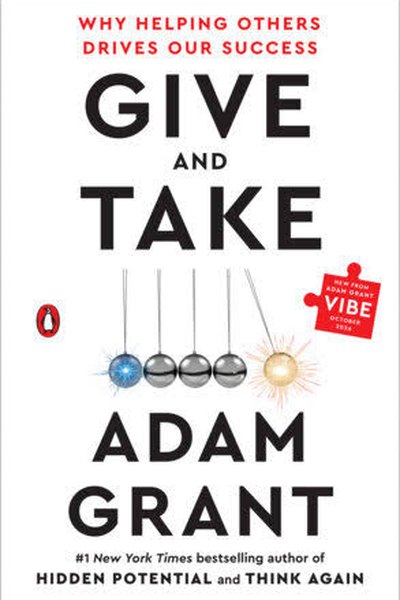
Give and Take
Is someone who always thinks of others first, and rarely speaks up for herself, doomed to lose?
That was my question when I picked up this book, because that's me.
Adam Grant is an organizational psychologist at Wharton and was one of the youngest tenured professors there. In this 2013 book he sorts people into three styles. Takers try to get as much as they can. Matchers trade evenly: you help me, I help you. Givers are happy to give more and don't keep score.
Givers are the most likely to finish last, and the most likely to finish first. This is the book's most counterintuitive finding. In one study of engineers in California, the most helpful ones were the least productive and made the most mistakes. At a Belgian medical school, givers had noticeably worse grades in year one. But by year six, the same givers were clearly outperforming their classmates, because the program had shifted from solo study to teamwork and patient care. The difference isn't how much you give. It's how you give.
Be an "otherish" giver, not a selfless one. Selfless givers get used and burned out. Smart givers look after their own interests too, and learn to tell who deserves their help. For takers posing as givers, try generous tit-for-tat.
Five-minute favors can weave a huge network. Grant profiles Adam Rifkin, whom Fortune named its best networker in 2011. His rule is simple: if a favor takes five minutes or less, he'll do it for anyone.
Honestly, the book overall was fine for me, not dazzling. A lot of it is stuff we already sense; Grant backs it up with a mountain of research and examples. But a few points have been genuinely useful. One is reconnecting dormant ties: people you used to know well but drifted from already trust you and can bring you fresh information, and when givers reach back out, people are more willing to help. Another is a finding that we make more accurate, more creative decisions when we're deciding for someone else rather than for ourselves. A third is that givers are better at cutting their losses when things aren't working.
So it didn't hand me a dramatic new answer. It did answer my question: caring about other people isn't a weakness, as long as you learn to protect yourself.
Read it if you've ever wondered whether nice people really do lose out.
Takers are black holes in a network. Givers are its sun.