Habits & Getting Started
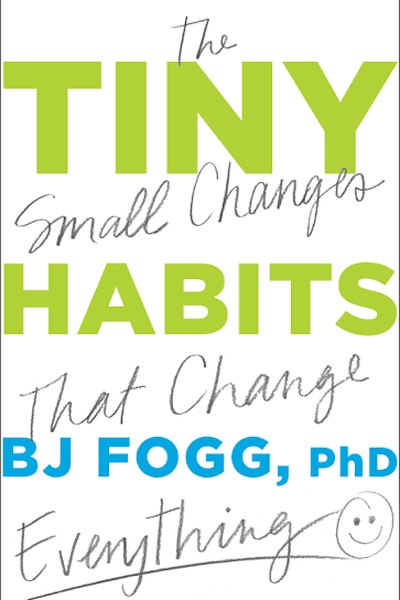
Tiny Habits
If a habit were as easy as flossing one tooth, could you still fail at it?
BJ Fogg founded the Behavior Design Lab at Stanford and has studied human behavior for more than twenty years. The "habit stacking" method in Atomic Habits? Clear got that from him. Fogg tried and failed many times to build a flossing habit. Then he changed the goal: after brushing, floss one tooth. Just one. Naturally, he rarely stopped at one.
The core of the book is a formula: B = MAP. A behavior happens only when motivation, ability and a prompt show up at the same moment. Take any one away and nothing happens.
Motivation is the least reliable of the three. Fogg compares it to a friend who's only good for a party. We make grand plans on the night we feel most fired up, and by morning the feeling is gone. He calls this the motivation wave, and it isn't your fault. That's just how motivation works. The way I see it, strong motivation is a push. A bigger push gives you a faster start, but how far you go depends on friction and steady support along the way.
Instead of asking "Why can't I do this?", ask "How can I make it easier?" Reading this, I asked myself something that stung: why can't I study English every day? Fogg's answer isn't "Try harder." It's to find the weakest link in your ability chain. Is it time? Energy? Is the task itself too mentally demanding? Then shrink it until you can do it with no motivation at all.
Hang the new habit on an old one, then celebrate. His recipe is ABC: an Anchor, something you already do; a tiny Behavior, the smallest version of the new habit; and a Celebration, an instant feeling of "I did it." His most famous example: every time you pee, do two push-ups. Habits aren't carved in by repetition. They're wired in by that flash of good feeling.
Life is your lab. There are failed experiments, not failed people.
The book also gave me a new way to see my work as a content creator. Fogg says the later in the day it gets, the harder it is to make complex decisions, and by Friday night people's drive for self-improvement has all but vanished. My own numbers came straight to mind: Friday posts have to be light, or they flop, while on Sunday evenings people want substance again. Which made me think I'd been posting at the wrong times. I wasn't fighting my readers' laziness. I was fighting their motivation curve.
Read it if you've made a hundred plans and every one died on day three.
Motivation is like a party-animal friend. Great for a night out, but not someone you would rely on to pick you up from the airport.