Letting Go & Paying Attention
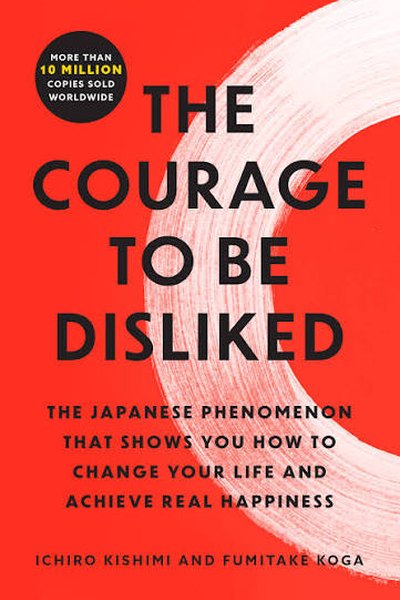
The Courage to Be Disliked
What if someone told you that you don't stay home because you're anxious, but that you make yourself anxious because you don't want to go out? Wouldn't you want to argue?
That's the kind of provocation this book opens with. The whole thing is a dialogue. A young man who is deeply unhappy with his life visits a philosopher several nights in a row, determined to tear apart his claims that people can change, the world is simple, and anyone can be happy. The young man gets angry every time. So do you, reading along. And then, slowly, you're persuaded.
What the philosopher teaches is the thinking of Alfred Adler, the Austrian psychologist. Adler was Freud's contemporary but went the opposite way. Freud asked, "What happened in your past to make you like this?" Adler asked, "What purpose does being like this serve for you now?" The book came out in Japan in 2013 and sold millions of copies across Asia.
You're shaped not by what happened to you, but by the meaning you give it. This is Adler's teleology. It's harsh, because it takes away every excuse. It's also kind, because if I chose who I am now, I can choose again.
All problems are interpersonal problems. Feeling inferior included. If you were the only person on earth, you'd never feel short. "I can't succeed because I don't have the right degree" is what Adler calls an inferiority complex. Underneath, it's not wanting to take the step.
Separate the tasks: first ask, "Whose task is this?" Whether people like you is their task. How you live is yours. Don't interfere in other people's tasks, and don't let them interfere in yours. That's why the philosopher says: freedom is being disliked by other people. Not going out of your way to annoy anyone, but accepting the cost of not pleasing everyone.
Life isn't a line. It's a series of moments. If life were a climb, everything before the summit would be a temporary life "on the way." But life only exists right here, right now.
The first time I read it was years ago. My biggest takeaway: the me right now is already the best me. I don't have to wait until I'm "good enough." I still ask myself whether I can truly stop caring what others think. My answer today: not completely. But I can tell whose task it is.
The book has plenty of critics. One reviewer argued that it pins all personal misfortune on "your choices" and ignores real social and economic conditions. I agree with that. So I treat it as a sharp, useful knife, not a whole worldview. In this group it's the most worldly book. The others teach you how to live with your own thoughts. This one teaches you how to live with other people's eyes on you.
Read it if you worry constantly about how others see you, or keep using your past to explain your present.
The important thing is not what one is born with but what use one makes of that equipment.