Stories, Poems & the Wider World
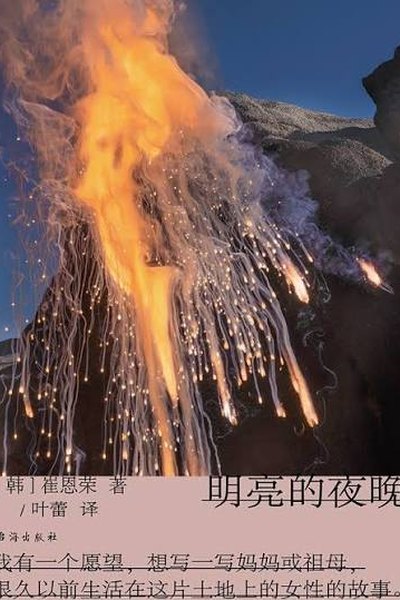
Bright Nights
Jiyeon is in her early thirties. Her husband cheated, the marriage is over, and she and her mother are barely speaking. She leaves Seoul for Huiryeong, a small seaside town, and there runs into the grandmother she hasn't seen in over twenty years.
At first neither of them knows what to say. Then, in an old photo album at her grandmother's place, Jiyeon finds a picture of a woman who looks just like her, leaning against her grandmother as a girl. It's her great-grandmother.
Her grandmother starts telling stories, and they begin in the 1930s. Her great-grandmother, Samcheon, was a butcher's daughter in Hwanghae Province, a background people looked down on at the time. At seventeen, to avoid being taken by the Japanese, she left home with a man. In the new place she met a woman named Saebi, and the two became friends for life. When war separated them, letters were what kept them going.
The novel follows four generations of women: great-grandmother, grandmother, Jiyeon's mother, and Jiyeon herself. Colonial rule, war, arranged marriage, and the silences and hurts a family hands down: it's all there.
Family can be a chain. The bonds women choose with each other can be the light. Samcheon and Saebi aren't related, yet they understand each other better than family ever did. Their thread is the tenderest part of the book.
Hurt gets passed down. So does understanding. The grandmother couldn't give her daughter the love she needed, and the daughter couldn't give it to Jiyeon. Only when Jiyeon is willing to listen to her grandmother's stories does the broken line start to reconnect.
What the author cares about is how people go on living while carrying pain. Choi has said that what interests her isn't suffering itself, but people who keep trying to live while they carry it. She has also said the book was something she was telling herself: she hopes readers can put down their self-loathing and stop being so hard on themselves.
This is a book to read slowly at night. When you finish, you may want to call your mother or grandmother and ask what she was like when she was young. Read it if there's a distance between you and the older women in your family that nobody talks about.
In one of the book's letters, every flower and every blade of grass becomes a reminder of the friend far away.