Motivation, the Brain & the Systems Around Us
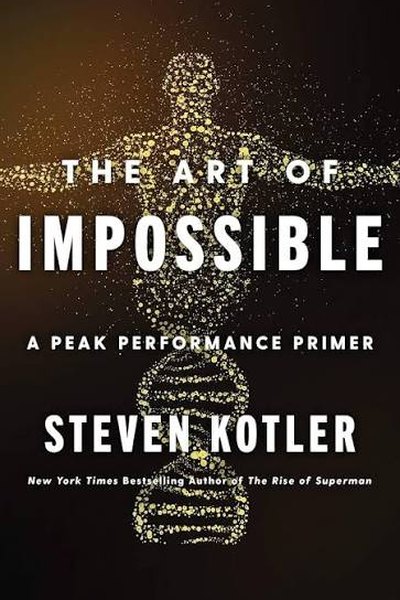
The Art of Impossible
The people who seem terrifyingly disciplined may not be using much willpower at all.
Steven Kotler started out as a journalist and went on to found the Flow Research Collective, an organization devoted to studying flow. For decades he has followed extreme athletes, scientists and entrepreneurs around, trying to answer one question: how do people actually pull off the impossible? His answer is refreshingly unmystical. Get your brain's biology working for you instead of against you.
There's a story in the book I love. Big-wave surfer Laird Hamilton rode a fifty-foot wave that everyone said couldn't be ridden. His response, roughly: you didn't see me start on three-foot waves as a kid, and you didn't see me ride a forty-nine-and-a-half-footer last week. "Impossible" is just a stack of small impossibles, one on top of the other.
Kotler breaks the skill into four parts: motivation, learning, creativity and flow. The motivation section is the most useful. You start with curiosity and layer it up into passion, then purpose, autonomy and mastery. The method is down to earth: write down 25 things you're genuinely curious about, find where three or four of them overlap, and feed that overlap for twenty or thirty minutes a day.
Passion doesn't make you tougher. It makes you able to endure. This is the most clear-eyed idea in the book. Chasing what you love mostly doesn't feel like joy. It feels like anxiety and frustration. Passion won't make those feelings go away; it just lets you carry them.
Curiosity alone isn't enough. You also need a little outside success. Running on curiosity, the spark dies fast. Positive feedback from other people gives your brain an extra reward, and that's what keeps the fire going.
It takes three positive thoughts to outweigh one negative one. This is psychologist Barbara Fredrickson's "positivity ratio," which Kotler cites. (The precise 3:1 figure has since been challenged; the math behind it was partly withdrawn in 2013. But the direction still works for me: negative thoughts weigh more, so you have to deliberately give yourself more positive feedback.)
What moved me most is that the book explained why I've kept reading at all.
I've always known I'm curious about everything, but there's a river between wanting to read something and actually reading it. What got me across was co-hosting the podcast Another Me. Having a partner, having listeners subscribe and tune in, getting the occasional comment: that's exactly the outside success Kotler is talking about. So I'm now happy to admit that a big part of why I post on social media is that it helps me keep going.
It also explained why I take reading notes. If you skim and never really sink in, your brain barely leaves a trace, and in the end you remember nothing.
I even found the answer to a jump-rope session in here. The first stretch was miserable, then around the twenty- or thirty-minute mark I suddenly came alive and kept going for almost an hour. That was endorphins. The book taught me to tell two kinds of high apart. If you finish a workout already planning a harder challenge, that's dopamine making you want. If you just feel calm and satisfied, that's endorphins letting you enjoy the moment.
Kotler also says creativity needs ammunition, and I couldn't agree more. To connect the dots, you first need dots. When I go a long stretch without reading, trying to come up with podcast topics is like staring at a blank wall.
Read it if you think you're "not disciplined enough," or if you're curious about a hundred things but keep losing steam after a week. It won't pump you up. It hands you the user manual.
Passion doesn't make us grittier. It lets us tolerate the negative emotions that come with sticking at something for the long haul.