Habits & Getting Started
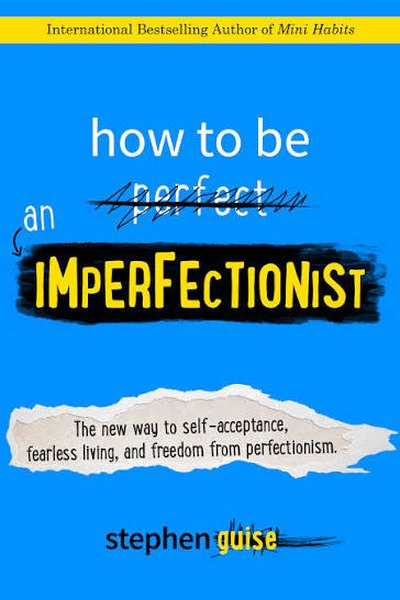
How to Be an Imperfectionist
Have you ever bought a beautiful new journal and then been too scared to make the first mark?
I have. I wanted it to end up as perfect as the ones I'd seen online, so I was afraid one wrong stroke would ruin the whole thing. Editing vlogs is the same. There's no such thing as the perfect vlog, and I can still burn half a day hunting for the right background track. So when I opened this book, I was thinking: this is a problem I've had forever, and I really need an answer.
Stephen Guise also wrote Mini Habits, which started in a funny way. He wanted to work out for thirty minutes and just couldn't start. So he set a goal of one push-up a day. It was too small to fail, and it ended up turning into a habit of going to the gym several times a week. This book takes the same approach to perfectionism.
Perfectionism is an iceberg. Above the water is the desire for perfection. The ninety percent below is fear of failure. Set the bar impossibly high and you get to not do the thing, while holding on to the fantasy that you'd be great at it. If you never try, you can never be proven not good enough.
Perfect is the enemy of done. This is the line I'd add three exclamation marks to. Perfectionism doesn't work because it assumes great work can be done in one go, and that almost never happens.
Define success in binary terms. This is the most practical tool in the book. Flipping a light switch is a "digital" task: you either did it (1) or you didn't (0), and tripping on the way doesn't change that. Giving a talk is an "analog" task: it can always be better. Guise's advice is to rewrite analog tasks as digital ones. Define a successful talk as "I got on stage and said what I came to say." If you said it, that's a 1.
Keep high expectations for life, low expectations for today. Believe your life will keep getting better, but don't expect much from this particular talk, this post, this attempt. Flip it around, with sky-high expectations for each try and constant misses, and your overall confidence wears down bit by bit.
One passage stopped me for a long time. Guise describes people who deliberately play down their achievements because they feel they don't deserve them. My first reaction: that's exactly me. I really dislike talking up anything I've done, because I feel I'm nowhere near good enough. The book didn't cure me overnight, but it showed me this isn't modesty. It's just another form of fear.
The first half is excellent. The second half repeats itself, so pick and choose.
Read it if you're always waiting for the perfect start.
Care less about doing it right. Care more about doing it at all.