Letting Go & Paying Attention
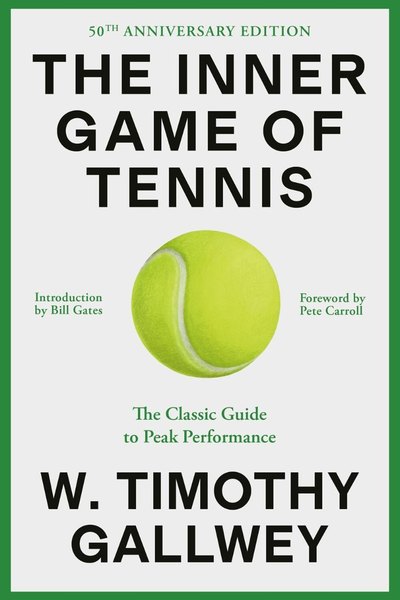
The Inner Game of Tennis
Why does trying harder so often make you worse?
Timothy Gallwey captained the Harvard tennis team and later became a coach. He noticed something odd: the more instructions he gave his students, the worse they played.
Two of his students stuck with me. One was Dorothy. He asked her to finish her follow-through a little higher. Instantly her face, forearm and grip all tightened, and her swing actually came out lower. The other was Paul, who had never held a racket. Gallwey didn't explain anything. He just had Paul watch him hit ten forehands. Paul's very first swing was startlingly smooth. His only mistake was forgetting to move his feet, which was the one thing he had consciously tried to remember.
From this Gallwey built his big idea: each of us has two selves. Self 1 is the voice that gives orders and passes judgment. "Lower your wrist." "That shot was awful." Self 2 is the body itself, and it's a natural learner. Nobody taught you grammar when you learned to walk or talk. The problem is never that Self 2 isn't good enough. It's that Self 1 won't shut up.
The book came out in 1974 and spread far beyond tennis. It helped give rise to the whole coaching industry, and Gallwey ended up teaching executives more than athletes.
Stop judging, and change happens on its own. Gallwey had students simply notice where the racket was, without calling it good or bad, and the stroke often corrected itself. Even praise is risky. Self 1 hears a compliment as a hidden threat: "They liked that one. What if I can't do it next time?"
Show your body a picture, don't read it instructions. Self 1 thinks in words. Self 2 thinks in images. Instead of reciting what your wrist should do, really watch someone who does it well, then let your body copy the feeling.
You don't have to break the old habit. Just take a new path. Kids don't "quit crawling." They just discover that walking works better.
I felt this firsthand learning to dance. Following the teacher, watching closely and copying, I danced pretty well. But the moment it was time to film myself, Self 1 jumped in: "What if you forget the steps? How embarrassing." My moves fell apart on the spot.
There's another exercise in the book I love: role-playing. Pretend you're acting in a TV show, playing a top player. Where the ball goes doesn't matter. You just have to perform that confidence. To me this is different from positive thinking. Positive thinking tries to convince you that you're good enough. Role-playing skips the convincing and lets you rediscover what you can actually do by trying.
Read it if you fall apart the moment someone's watching, or if you're learning any physical skill.
Real learning isn't collecting information. It's an insight that actually changes what you do.