Stories, Poems & the Wider World
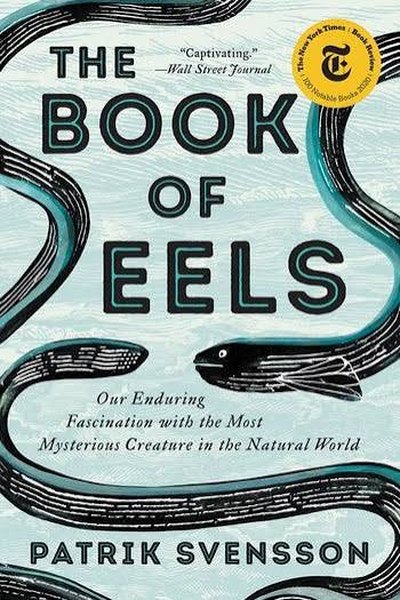
The Book of Eels
For more than two thousand years, people couldn't answer one simple question: where do eels come from?
Aristotle couldn't find their reproductive organs and concluded they must arise from mud. A nineteen-year-old Sigmund Freud dissected hundreds of eels in Trieste hunting for male testes and found nothing. Only in the early twentieth century did the Danish marine biologist Johannes Schmidt, after nearly twenty years of sailing the Atlantic and netting smaller and smaller eel larvae, trace their birthplace to the far-off Sargasso Sea. Even today, no one has ever seen eels mate or spawn in the wild.
Svensson is a Swedish culture journalist, and this, his first book, won the August Prize, Sweden's top literary award. It has eighteen chapters. The odd ones cover the science and history of eels. The even ones are memories of fishing for eels at night by the river with his father. One thread chases the eel. The other chases his father.
After finishing it, I couldn't stop thinking about an eel's life. It sets out from the Sargasso Sea as a transparent, willow-leaf-shaped larva and drifts across the entire Atlantic. It becomes a glass eel and swims into Europe's rivers, then a yellow eel, living alone in some quiet hollow. If it never breeds, it can live fifty years or more. Catch it and release it miles away, and it will find its way back home.
But one day it suddenly turns into a silver eel. It stops eating, swims thousands of kilometers back to where it was born, spawns, and dies.
Somewhere inside it is a terrifying genetic will that decides a life should go off to die. That was my strongest feeling at this point in the book. It moved me with how astonishing life is, and it also scared me.
The eel question sits where faith meets science. Because our knowledge is incomplete, the eel has become a place where fact and myth live side by side. Our understanding of the world often stops at exactly this kind of border.
Wherever we come from is where we eventually return. Writing about his father, Svensson is really writing about himself: how to understand a quiet man who only spent real time with him on those nights by the river, and how to understand where he himself came from.
And this mysterious creature is disappearing. The European eel is now critically endangered. We may lose it before we ever understand it.
Read it if you liked how Why Fish Don't Exist turns science into philosophy, or if you've lately been asking where you come from and where you're headed.
The eel, in Svensson's telling, lives where faith and science overlap, a place where fact and myth share the same water.