Stories, Poems & the Wider World
Flatland: A Romance of Many Dimensions
If you were a square living your whole life on a sheet of paper, and someone visited you from "above," how would you even begin to understand the word "above"?
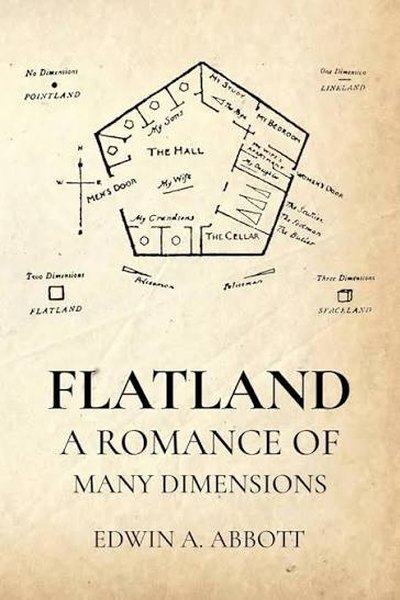
Flatland came out in 1884. Its author, Edwin Abbott, was a clergyman, a theologian and the headmaster of a London school, and he published it under the pen name "A Square." You'd expect a stuffy Victorian. Instead he wrote a strange little book that hasn't gone out of print in over a century: part primer on dimensions, part wild science fiction, part savage social satire. I love it because it uses a geometry fable to show how blind we are to our own limits, and it manages to be funny and painful at the same time.
The narrator is a respectable Square. In Flatland, the more sides you have, the higher your rank. Soldiers and workers are sharp-angled isosceles triangles, the middle class are equilateral triangles, and at the very top sit the priests, polygons so many-sided they're nearly circles. Women are straight lines. They can never rise, and in public they must keep up a constant "peace-cry" so men know to get out of the way.
The detail that gave me chills: the Circles deliberately leave one narrow path upward. Every so often an isosceles triangle has a child who is born equilateral, and the whole city celebrates. That little flicker of hope works better than any crackdown. Sometimes what stops people from fighting back isn't despair. It's just enough hope.
Then, halfway through, the book blows wide open. The Square dreams of Lineland, a world that is a single line, whose king is certain that line is the entire universe. Later a mysterious Circle visits him, growing and shrinking and vanishing into thin air. It turns out to be a Sphere from the third dimension. The Square is lifted out of his plane, and when he returns he tries to tell everyone the truth. I won't say how that goes. I'll only say that the phrase he keeps repeating became the most famous line in the book.
The sharper the angle, the lower the dimension. A triangle's eyes sit far from its own point, so it never sees who it's stabbing. The way I read it: the fewer limits you have, the lower your dimension and the more you attack. And the closer you grow toward a circle, the more you can take in, and the more forgiving you naturally become.
Not seeing isn't the scary part. Taking your blindness for granted is. The King of Lineland and the King of Pointland are perfectly content, because they can't imagine anything beyond themselves. The problem isn't that our understanding is narrow. It's how comfortable we are with that narrowness.
You think you live in three dimensions. You're a Flatlander too. This is the book's most delicious twist. The Square asks the Sphere: if there's a third dimension, why not a fourth? The wise, enlightened Sphere, who has been so patient and lofty the whole time, flies into a rage. And suddenly we readers, who've been chuckling down at the Flatlanders, are standing exactly where they stood: unable to know, unable to imagine.
In the afterword to the Chinese edition, the translator jokes that he assumed a book by a clergyman would be dull, then realized by the end that he was the King of Pointland, sure he was "the All in All." Now, whenever someone seems impossible to reason with, I try to ask myself first: am I just standing on my own little line?
Read it if you loved the "dimension-collapse" moments in The Three-Body Problem, or if you want one book that lets you talk about math, class and gender in the same breath. It's thin. A weekend is plenty.
Upward, not Northward.